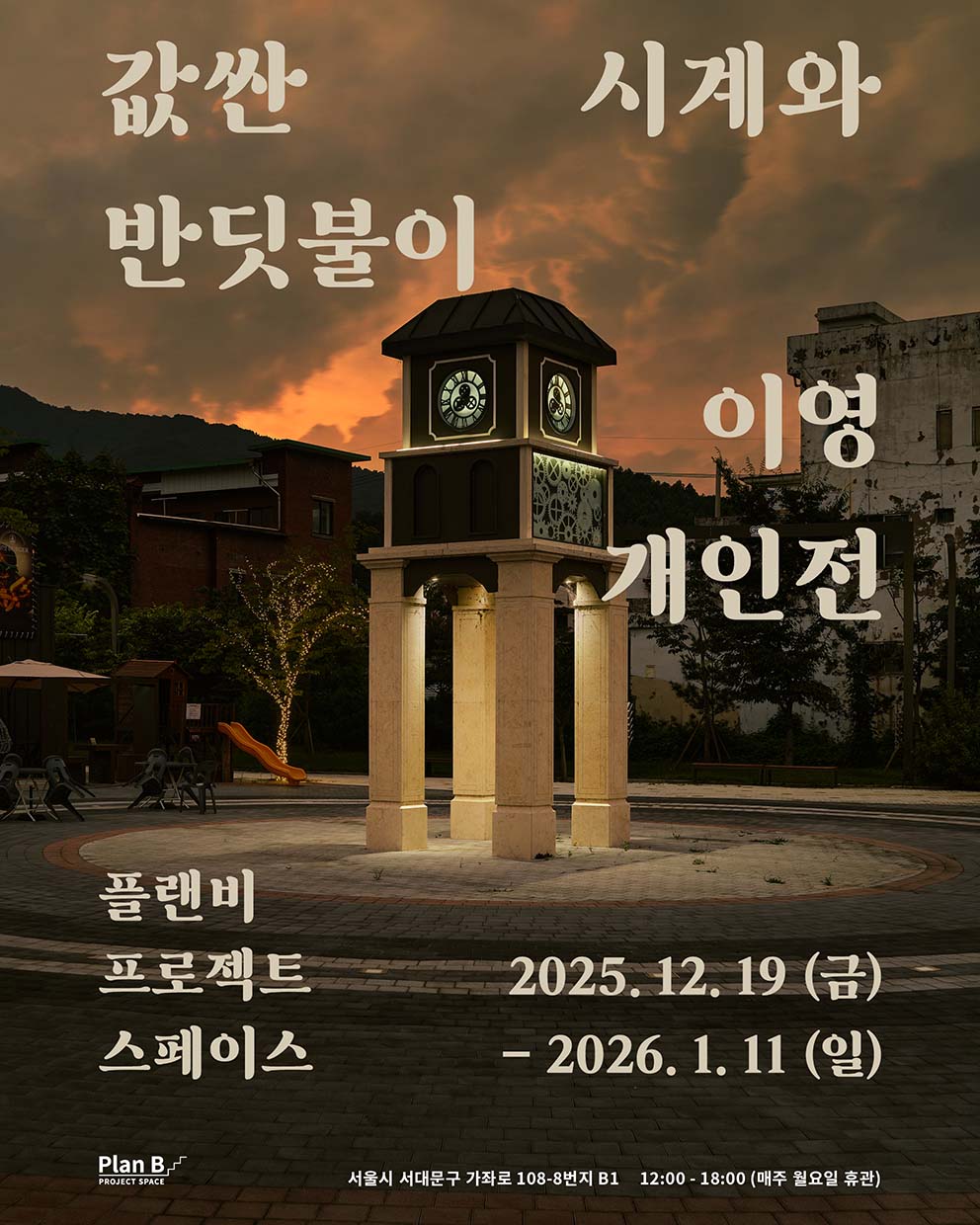
플랜비 프로젝트 스페이스 인스타그램 / PlanB project space
이영

Words on the Surface:
Continuities and Expansions of Signboard Records Originating from the Hwanghak-dong Everything Market
This body of work began by examining the local specificity of secondhand traditional markets. Signboards reveal distinct characteristics through their typographic formal qualities and through clusters of words that can be grouped into categories. This investigation led to the subsequent project Peace and Unification, which explores the reality of national division, while the collection of hand-painted signboards has continued in parallel. The accumulated works were organized into a solo exhibition at Label Gallery, followed by several collaborative projects. Through this process, the boundaries of the work were gradually expanded. Rather than remaining within mechanical repetition, the practice began to incorporate image-transfer techniques and previously overlooked materials. Works such as Scales, which employs transfer processes, and Loose Jumper, which uses plastic bags, mark an expansion toward more active modes of engagement grounded in text.

Irreducible Things:
From Nonlinear Time to an Ecological–Ethical Sensibility
Inspired by Park Kyung-ni’s poem Jujube and the Honeybee, this series records landscapes where urban plants and artificial structures coexist. Abstract concepts and emotions are approached through concrete subjects and specific situations. Rather than being resolved or reduced, life and death, as well as the formation and dissolution of subjectivity, are accepted as irreducible conditions. This sensuous acceptance forms a foundational attitude of the work. From an awareness of non-linear time, an ecological–ethical sensibility gradually emerges. As this attitude intersects with reflections on photography’s ontological stance, the practice unfolds through the recognition of organic structures and responsive engagement with them. In this process, the work does not move toward abstraction, but instead allows everyday sensibilities to appear as sites where irreducibility is sustained.

Structures in Formation:
Recording Events and Discovering Types
This ongoing project records the presence of so-called jeoksan-gageok— houses left behind during the colonial period that remain embedded within contemporary urban environments.
Chungmuro, despite its name, is often perceived as a place marked by historical atmosphere. As external conditions change, perceptions of locality also shift.
Networks grow increasingly dense and extend flexibly across boundaries. As regional specificity becomes diffuse, the universal characteristics of structure begin to surface.
This work follows the flow of types, functioning simultaneously as a process of recording and one of discover
Entangled Threads, Moon Jar
A time machine will never appear.
The world is repeatedly reassembled around certain memories.
There is no objective fact to return to, and therefore no use for such a device.
There is no beginning, and no final closure.
If one were to trace my photographs of signs, the portfolio would mark *Manmul Market* (2007) as the starting point. But that was only a result. Or perhaps a cause.
The thread reaches further back.
In 1997 or 1998, after a school trip, my mother scolded me for photographing useless things—explanatory signs and directional markers. Even then, I rarely photographed people.
Ten years earlier, in 1986 or 1987, I walked with my mother along the commercial street across Nambu Market, reading every sign aloud without pause. She praised me at first, then asked me to stop, exhausted.
No photographs remain from that time.
My mother has never been attached to photographs. When we moved to Wonju, everything was lost. One remaining image—perhaps from my first birthday—was given away after a shaman warned that I might die young. I have since outlived my father’s age. Perhaps it worked.
In truth, I am similar.
When I lose rolls of film, or erase original digital files, I simply photograph again. I do not see the world as a chain of specific events, but as a sequence of recurring reorganizations. Still, I resist speaking of this in abstract terms.
Time unraveling endlessly, like a loose thread, holds little meaning for me.
A moon jar appears different depending on where one stands, yet its form remains unchanged. This is why I chose the title. The jar invites the perception of a perfect circle—a geometry that does not exist in reality. A Gestalt world. Perhaps this is the most binding illusion: the helplessness suspended between the ideal and the real.
Losing all my photographs would be difficult, but not impossible.
During a mixed-media class at Keimyung University, we were asked to extend expression by scratching directly onto film. I photographed mannequins through a small window in a locked storage room. There was no alternative viewpoint. I scratched every frame and submitted them all.
I said I could photograph it again.
The professor replied that if I could reproduce the same image, I would receive the highest grade.
I returned. The door was still locked. I stood in the same place.
But the mannequins had moved.
I understood then that the same photograph cannot exist.
This was not merely irreversibility. The configuration had changed, but the room remained sealed. The mannequins were still standing. Nothing essential had altered.
There was no clear trajectory. No dream to follow.
As a child, I may have written “scientist” once. I do not remember anything after that. I entered photography almost accidentally, without even owning a camera. I continue not because of intensity or ambition, but because I do not stop easily.
After returning from military service, I briefly worked harder than usual. I discovered *punctum* too quickly—an unremarkable brown mark on my back. Something I had forgotten until that moment.
Eventually, I began to avoid photographs that produced deliberate discomfort. What Barthes called *punctum* felt less like revelation than an alibi. A justification that escaped structure. I learned to use it when necessary, but I no longer trusted it.
Returning to the foundations of photography felt inevitable.
Photography is a precise record of a moment. This apparent certainty compels doubt toward reality itself. At its limit, it becomes abstract.
What modern photographers achieved was not merely technical mastery, but the opening of conceptual expansion. They made it possible to draw a circle from a moon jar. A closed system formed by imperfect asymmetry and multiple centers. A world without directional progress—only recombination.
Such a world can exist only by accepting the imbalance between what cannot be reconciled.
This Text Does Not Explain the Work
More than ever, I am concerned with how my work is understood by others. For a long time, I did not call it “work.” The word felt unfamiliar, slightly uncomfortable. I would say, simply, “I take photographs.” Not my work, but my photographs.
Perhaps this was because I understood that “work” is not simply a result, but something that takes form through the interaction of attitude, direction, and relation. Abstract language often sounds declarative, so I avoided it. And because work does not necessarily resolve into its outcomes in any clear way, I postponed naming it as such.
Over the past few years, after going through various open calls and portfolio reviews, I became more aware of how my work was being received. I felt positioned at a boundary, at the periphery. Partly because I am not articulate, but perhaps the first button had been fastened incorrectly from the beginning. More than my temporary despair, I recognized that there was little left to expect.
A way of living cannot be separated from work. A medium can move beyond its essence only through an understanding of that essence, from which other possibilities may emerge.Photography engages time and space more directly than any other medium. Photography and moving image are often grouped together out of convenience, but they are fundamentally different. Moving image follows a narrative structure of cause and effect, and through editing, it erases coordinates of time and space to construct an independent spatiotemporal order. In this sense, it resembles painting: a composed world. Ultimately, moving image represents time and space, rather than dealing with them directly.
The spatiotemporal sensibility of photography, on the other hand, is bound to concrete physical reality. This also means that basic mechanics are at work. Within a dynamic field in which political, social, cultural, and historical relations are inseparably entangled, the subject emerges and disappears as a small field among others. Photography is inherently relational, as it cannot exist independently.
It occupies physical coordinates, but not merely as positional values— rather, as points of dense relational intersection. The “field” is the foundation of photography, yet it also tends to expand beyond the image frame, blurring its own form.Psychodynamic theorists built their frameworks on the assumption that the psyche possesses force and direction, and that it can be transferred. Nietzsche’s concept of eternal recurrence similarly demonstrated the possibility of affirmation and will through the recombination of finite matter within infinite time.
Within a closed system, total energy remains constant.
Energy may transform into various forms, but its total amount does not change.
— The First Law of Thermodynamics
Mental phenomena trace trajectories akin to physical laws, intertwining as a field, and work operates as a process of interaction within it. The resulting image goes beyond projection, revealing conditions of resonance in which structured moments allow recognition and response between entities.
Resonance occurs as a structural correspondence— repeatable in form and amplitude— even when existential forms differ.

Clouds. An expression employing projection or structural equivalence.
Alfred Stieglitz presented Equivalents using the motif of clouds. When he suggested that the clouds reflected his emotions, this may have been closer to projection— an intuitive, aesthetic approach. Because he left no explicit explanation, we cannot be certain.In photographic history, the work is often understood as a departure from pictorialism and the beginning of a subjective practice. Later theorists interpreted it as structural equivalence: the process and form of cloud formation resonated in amplitude with the artist’s lived fluctuations.
Though difficult to separate, if someone experiencing a similar impasse encounters resonance through Stieglitz’s work, that resonance cannot be reduced to emotion alone. Empirically, no two clouds—neither in a series nor in reality— are ever the same. Resonance emerges not from intuition alone, but from a structural response.

Henri Cartier-Bresson’s contact sheets. Repeated exposures in pursuit of a complete composition.
I understand structural approaches as a leap toward non-linear time. When an organically changing field is structured, it does not remain within sequential, causal time, but exists independently outside it.When Cartier-Bresson’s contact sheets were revealed, many may have felt disappointed by his notion of the “decisive moment.” The French title translates as Images à la Sauvette— images taken on the run— while the English title emphasizes decisiveness.
“For me, photography is the simultaneous recognition of an event’s meaning and the precise arrangement of forms that best articulate it. This occurs within a fraction of a second.”Yet the contact sheets reveal that countless repetitions were necessary to achieve formal completion behind a single finished image.
— Henri Cartier-Bresson
Through form—rhythm, balance, composition— he produced results. This was not a slice of linear time, but a structural moment that relocated reality outside time through recombination.
Even if a moment is “decisive,” it is articulated through an internal structure. Form becomes content. It was an optimized practice. Still, I required more intersections— moments reached not through individual subjects, but through resonance between structures.

Pepper. Expressing photographic form.
Opposite Stieglitz stood Group f/64, who likewise rejected pictorialism. While Stieglitz explored intuitive possibility, Group f/64 pursued the extremes of photographic clarity. Using the f/64 aperture, they achieved formal sharpness and absolute control.This represented the aesthetic transference of an objective photographic vision. At the same time, photography had already begun to extend beyond pictorialism, engaging the world through internal and external structures, expanding into a dynamic field.
Perhaps form can be more than a mode of expression— perhaps it is a method for approaching essence itself.

Anonymous Sculptures. Individuality revealed through structures of repetition.
Bernd and Hilla Becher arranged industrial structures in grids to enable typological comparison. Each building was independent yet part of a type, revealing aesthetic value through the repetition of difference and structural sameness.They called this Anonymous Sculptures. By reorganizing dispersed, individualized objects into structural systems, they generated meaning. This extends beyond documentation into ontology.
Without difference, type cannot be perceived. Without type, difference cannot be recognized. Typology becomes a condition for the appearance of individuality— and a way of encountering the other.
“Death is the possibility of Dasein’s ownmost being.”The subject exists temporarily within a flow. Existence expands toward the other through individuality. Death, uniquely embodied by each subject, is an absolute condition of individuality, yet it may also function as a condition of typology.
— Martin Heidegger
“The Other turns me into an object. Under that gaze, I am no longer myself.”
— Jean-Paul Sartre
As beings who recognize an end, our sense of physical, linear time forms a bounded field that continues to change organically. Individual fields may resonate with others through structure. Approaching across boundaries becomes possible through corresponding structures.
Thus, I perceive and respond to the structure of the other through my own. This is both a dismantling of the tendency to close oneself into completion, and an effort to expand relational networks into a larger field.
It is a non-destructive, non-violent approach— my ethical sense of distance. It is also my hesitation, and the enduring distance to the other, who can never be identical nor fully reached.
Resonance is my best attempt— one mode of existence.

Photography does not speak
about this person.
It is revealed
only through structure.
Artificial flower/ Young Lee
What is Closest Is Furthest Away
Living is a quiet act of drawing constellations, unnoticed by others. A plausible life, belonging to someone I will never know, feels less intimate than Orion, always there in the night sky.
In the early-morning elevator, someone who looked tired stepped in. The stale scent of rice lingered, and it brought back the memory of forcing down mouthfuls just to keep going. Even without anyone watching, I could not live that way.
Only by leaving home in the dark could I arrive at work on time. Eating was not optional. The work demanded it.
At the top of the subway stairs, where the bluish dawn sky meets the street, there was my grandmother’s gimbap stand. I went to work on my first day without knowing much, having eaten nothing, barely making it through the day. The next morning, I bought a single roll. One thousand won, perhaps. Or fifteen hundred. I wondered how anyone could make a living selling it that way.
With aching arms, I picked up the uncut roll, still fully wrapped in foil. Walking, I peeled it back with difficulty, losing what little warmth remained. What time had she woken up? She must have been exhausted.
With no appetite, I tore into the gimbap, forcing myself to eat, like a wild animal. My fingers would not close properly; every movement pulled at my forearms. As I struggled to bite and chew, I thought of my grandmother. A stomach that could not finish even a single roll could imitate nothing.
Like that day, from far off—whether stairway or sky— a man approached, a streetlight behind him, his figure blinking into view. His oversized jacket fluttered, making his light steps seem larger, almost like wings. The black plastic bag in his hand looked as if it held only a few cartons of milk. The way it kept swinging as he walked— as if confirming how little remained— it felt as if the bag itself was carrying his will.
I had somewhere to go that night, but his car was double-parked in front of mine. The handbrake was firmly set, almost too carefully. There was no phone number on the windshield. Momentarily at a loss, I looked for some way to reach him.
The car was so transparent that I couldn’t tell whether the back window was open or closed. I leaned in, then flinched, afraid I might collide with glass I assumed was there. Inside, children’s books lay stacked at an angle, and a small blanket barely cradled a green milk crate, now almost empty.
I pretended not to notice. I walked far enough away that he would not see me, like someone merely passing by. There was no need to go that far.
I pushed her away. No. I stepped back. She was transparent.
A white blouse, responding even to the slightest breeze. A long black skirt, out of season, made strangely brilliant— like spring flowers— by the awkward splay of her steps.
What if she had simply remained at a distance? She became farther than anyone who might plausibly exist. Having gone too far, she returns to me only from time to time.
She was someone I could not speak of while she was still close. Only with distance did it become possible to speak. She went too far. From beyond the reach of words, everything flowers.
Long ago, I behaved as if everything had already ended. It feels strangely new. Knowing that you left the world, I spent the night gasping for breath. How exhausting it must have been to carry a sleepless night all the way through.
Perhaps we were too close— close enough for me to know her too well. Even if the world quietly overturns itself again, the only change in my life is that I started using Instagram.
I hoped, by way of imitation, that my unremarkable life might become even slightly transparent. There was no time to be sincere.
I am still here. If anyone is sad, they may come. That was all.